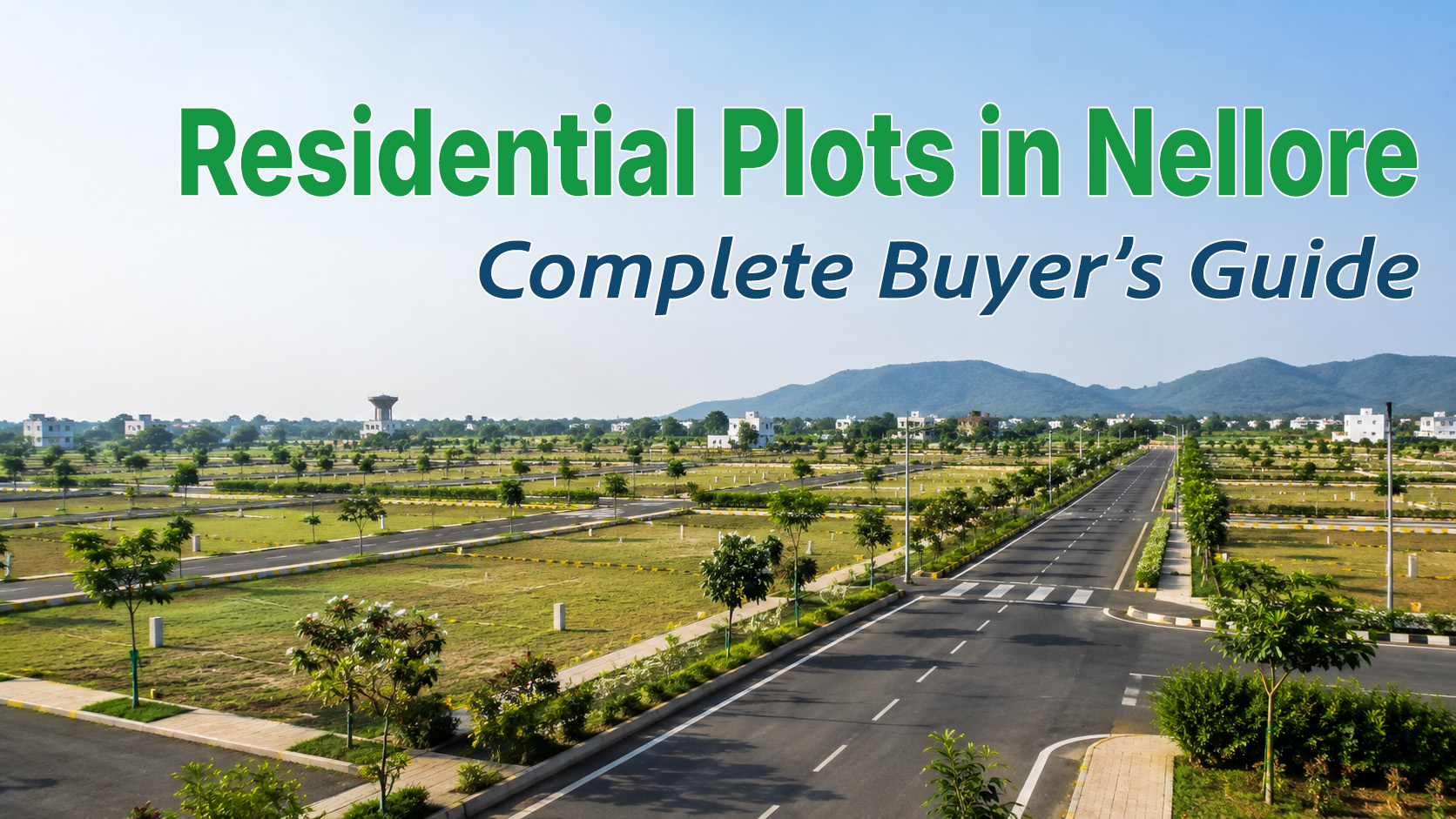
Residential Plots in Nellore: A Practical Buyer’s Guide
Plot Buying Guide
A practical framework for comparing locations, approvals, total costs, dimensions and site conditions before you book residential plots in Nellore.
Buying a residential plot gives you the flexibility to construct a home according to your requirements, budget and preferred timeline. However, selecting land requires more investigation than comparing only the advertised price or plot facing.
Buyers searching for residential plots available in Nellore will find options across established neighbourhoods, developing residential corridors, independent layouts and gated plotted communities. Each option can differ significantly in approval status, road access, surrounding development, infrastructure, plot dimensions and total purchase cost.
This guide explains how to evaluate plots in Nellore objectively before making a booking. It is intended to help homebuyers and long-term investors understand the practical, financial and documentation-related factors involved in purchasing residential land.
To compare current options, review the plotted development in Atmakur and residential plots near Brahmadevam, then confirm availability and project-specific details directly with the team.
Why are buyers considering residential plots in Nellore?
Residential plots appeal to different categories of buyers.
Some families purchase land to construct an independent house immediately. Others buy a plot with plans to build after a few years. Land may also be purchased for children, retirement planning or long-term asset ownership.
Compared with buying a completed apartment, purchasing a plot gives the owner greater control over:
- House design and room planning
- Construction quality
- Number of floors, subject to applicable regulations
- Parking arrangements
- Open spaces and landscaping
- Construction schedule
- Future extensions or modifications
However, land ownership also places greater responsibility on the buyer. The buyer must examine title documents, layout approval, access roads, plot boundaries, infrastructure and construction suitability before proceeding.
The right plot is therefore not necessarily the cheapest plot. It is the plot that best matches the buyer’s intended use, budget, preferred location and expected construction timeline.
What types of residential plots are available?
Before comparing plots for sale in Nellore, buyers should understand the main categories available in the market.
Independent plots
An independent plot is generally sold by an individual landowner or reseller. It may be located within an existing neighbourhood or an older layout.
Such plots can be suitable for immediate construction when the surrounding area is already developed. Buyers should nevertheless verify access roads, title documents, plot boundaries, utilities and applicable building rules.
Plots in planned residential layouts
These plots form part of a larger layout containing internal roads, designated open spaces, drainage provisions and individual plot numbers.
The quality of planned layouts varies. Buyers should confirm which infrastructure works are completed, which are under development and which are only proposed.
Gated community plots
Gated community plots may include an entrance gate, internal roads, landscaping, security provisions, parks, clubhouse facilities or other shared amenities.
Buyers should ask whether the amenities are completed or proposed and whether recurring maintenance charges will apply.
Resale plots
A resale plot has already been purchased by another owner and is being offered again. These plots may be available in established layouts, but the complete ownership chain and previous transaction documents must be carefully verified.
Corner and main-road plots
Corner plots and plots facing wider roads may provide better access, ventilation or commercial visibility in some locations. They may also attract additional pricing.
The additional cost should be evaluated based on actual utility rather than perception alone.
How should you choose a location in Nellore?
Location selection should begin with the purpose of the purchase.
A buyer planning to construct a house soon may prioritise established road access, nearby schools, hospitals, supermarkets and regular transportation. A buyer with a longer holding period may explore current Nellore projects in a developing residential area, provided the title, approval, access and future usability are satisfactory.
Evaluate every location using the following factors.
Connectivity
Check the actual travel route from the plot to important destinations rather than relying only on straight-line distance.
Consider access to:
- Main roads
- Employment areas
- Schools and colleges
- Hospitals
- Markets and supermarkets
- Public transportation
- Railway and bus connectivity
- Places regularly visited by the family
Visit the location during normal traffic hours to understand realistic travel conditions.
Approach road
The approach road connecting the layout to the nearest major road is as important as the internal roads.
Check:
- Whether the road is legally accessible
- Present road width
- Surface condition
- Whether two vehicles can pass comfortably
- Street lighting
- Drainage conditions
- Access during the rainy season
A well-developed internal layout is less useful when the external approach road is difficult to use.
Surrounding development
Observe whether the surrounding area has existing houses, active construction, schools, shops, electricity connections and public activity.
A developing locality is not automatically unsuitable, but the buyer should understand the current stage of development before purchasing.
Suitability for daily life
Buyers planning to build within a short period should assess whether the family can comfortably live in the area.
Consider availability of:
- Drinking water sources
- Electricity
- Mobile connectivity
- Groceries
- Healthcare
- Schools
- Transportation
- Waste collection
- Emergency access
Environmental conditions
Inspect the physical condition of the land and surrounding area.
Look for:
- Low-lying portions
- Waterlogging indicators
- Nearby drainage channels
- Uneven filling
- High-tension electrical lines
- Polluting activities
- Excessive noise
- Access limitations
- Natural water flow paths
Where possible, visit the location after rainfall or speak with residents in nearby areas.
Self-use versus investment: what changes?
The ideal plot depends on whether it is being purchased for home construction or long-term investment.
Buying for self-use
A self-use buyer should generally focus on:
- Convenient daily access
- House-friendly plot dimensions
- Road width
- Nearby habitation
- Electricity and water availability
- Construction feasibility
- Schools, hospitals and shopping
- Safety and neighbourhood conditions
For self-use, current habitability may be more important than speculative future development.
Buying for long-term investment
An investment-focused buyer may consider:
- Planned infrastructure
- Development activity
- Future residential demand
- Marketability of the plot
- Approval and documentation
- Road connectivity
- Holding period
- Ease of resale
- Total acquisition cost
No location or plot can guarantee appreciation. Land values are affected by demand, infrastructure, economic conditions, documentation, development activity and the buyer’s holding period.
Buyers should avoid making decisions solely on verbal appreciation projections.
Which approvals and documents should be checked?
Documentation is one of the most important parts of buying residential land.
The required documents can vary depending on the property, location, project type and transaction structure. Buyers should obtain independent legal advice before paying a substantial amount or completing registration.
Common documents and details that may require verification include:
Layout approval
Ask for a copy of the approved layout plan and identify the competent authority that issued the approval.
Verify that:
- The approval document relates to the same land
- The plot number appears in the approved plan
- Road widths match the layout
- Open spaces and common areas are correctly shown
- The physical plot corresponds with the approved drawing
Do not rely only on approval logos printed in marketing material.
Title documents
The seller or developer should be able to provide documents supporting ownership of the land.
A property lawyer may examine:
- Parent documents
- Previous sale deeds
- Link documents
- Ownership continuity
- Survey details
- Boundaries
- Rights of access
- Claims or disputes
Encumbrance Certificate
An Encumbrance Certificate can provide information about registered transactions affecting the property during the period covered by the certificate.
It should be reviewed together with the broader title documentation rather than treated as the only proof of ownership.
Survey number and plot identification
Confirm the survey number, plot number, dimensions, boundaries and total area.
The details should remain consistent across:
- Layout plan
- Cost sheet
- Booking form
- Agreement
- Sale deed
- Physical site markings
Regulatory registration
Where a project falls under applicable real estate regulatory requirements, buyers should verify the registration details through the relevant official portal.
The project name, promoter, land details and registration status should correspond with the documents shown by the seller.
Tax and revenue-related records
Depending on the property, a lawyer may recommend reviewing applicable tax receipts, revenue records, mutation details or other land records.
Access rights
A residential plot must have lawful and usable access.
The presence of a road on the ground is not always sufficient. The legal documents and approved plan should support the right of access.
Understanding plot size and dimensions
Plot area is commonly expressed in square feet, square yards, cents, acres or locally used measurement units.
Buyers should avoid relying only on informal verbal conversions. The final area and dimensions should be clearly recorded using recognised measurements in the transaction documents.
Two plots with the same total area may have very different construction potential.
For example, one plot may have a practical rectangular shape with sufficient road frontage, while another may be narrow, irregular or affected by a corner cut.
Important measurements include:
- Total plot area
- Road-facing width
- Plot depth
- Shape
- Corner dimensions
- Setback requirements
- Direction of the road
- Level difference between road and plot
Before buying, discuss the plot dimensions with an architect or engineer, especially when you already have a particular house plan in mind.
Does plot facing matter?
Many buyers in Nellore have preferences regarding east-, west-, north- or south-facing plots.
Facing can influence personal preference, house planning, sunlight, ventilation and the placement of the entrance. However, it should not be evaluated in isolation.
A preferred-facing plot may still be unsuitable when it has:
- Poor access
- Impractical dimensions
- Documentation issues
- Low road level
- Waterlogging
- Insufficient frontage
- Unfavourable surroundings
A well-planned house can often be designed on different plot orientations. Buyers should evaluate the complete property rather than selecting solely by facing.
How do road width and corner location affect a plot?
Road width affects access, parking, construction activity and the overall experience of the layout.
Wider roads may be useful for:
- Easier vehicle movement
- Construction-material delivery
- Parking
- Better visibility
- Reduced congestion
- Long-term neighbourhood usability
Corner plots have roads on two sides and may offer additional ventilation or design flexibility. At the same time, applicable setbacks or corner-cut requirements may affect the usable building area.
Some projects charge additional amounts for corner plots, preferred facing or wider-road locations. Ask for a complete written cost sheet showing all premiums before booking.
How should you compare plot prices?
The advertised price per square yard, square foot or local measurement unit does not always represent the complete purchase cost.
Compare plots using the total payable amount.
The complete cost may include:
- Basic plot price
- Corner charges
- Facing charges
- Wider-road charges
- Development charges
- Amenities or clubhouse charges
- Maintenance deposits
- Documentation charges
- Applicable taxes
- Registration expenses
- Legal verification expenses
- Loan processing charges, where applicable
Request a written cost sheet that clearly identifies included and excluded charges.
When comparing two residential plot projects in Nellore, also compare:
- Approval status
- Location
- Approach road
- Internal road width
- Drainage
- Electricity provisions
- Water arrangements
- Plot dimensions
- Completion stage
- Surrounding development
- Maintenance requirements
- Developer track record
A lower base rate may not always result in a lower total cost or better long-term usability.
What infrastructure should a plotted layout provide?
The infrastructure expected from a residential layout depends on the project category, approval conditions and commitments made by the developer.
Buyers may examine the availability or proposed status of:
- Internal roads
- Drainage
- Electricity lines
- Street lighting
- Water provisions
- Plot demarcation
- Avenue plantation
- Parks
- Footpaths
- Security arrangements
- Sewage provisions
- Common amenities
Ask for a written list separating completed infrastructure from proposed infrastructure.
During the site visit, inspect whether the visible work matches the project information provided.
Residential plot site-visit checklist
Never select a plot only through photographs, videos or maps. Visit the location personally or send a trusted representative.
Use this checklist during the visit.
Location and access
- Confirm the route from the nearest major road.
- Inspect the approach-road condition.
- Check whether the location is accessible during all seasons.
- Observe traffic and travel time.
- Save the location coordinates.
Plot identification
- Match the plot number with the layout plan.
- Verify physical markings.
- Confirm the road-facing side.
- Check frontage and depth.
- Examine the shape of the plot.
- Identify neighbouring plots and common areas.
Ground conditions
- Compare the road level with the plot level.
- Look for signs of waterlogging.
- Observe soil filling and uneven surfaces.
- Check drainage direction.
- Look for nearby water channels or low-lying areas.
Infrastructure
- Inspect internal roads.
- Check drainage work.
- Look for electricity infrastructure.
- Ask about water arrangements.
- Verify the status of parks and amenities.
- Distinguish completed work from proposed work.
Surrounding area
- Observe nearby houses and construction.
- Identify schools, shops and hospitals.
- Check mobile connectivity.
- Speak with local residents when possible.
- Visit during daylight.
Documentation
- Ask for copies of relevant approvals.
- Obtain the complete cost sheet.
- Verify the payment schedule.
- Request draft transaction documents.
- Complete independent legal verification.
Common mistakes to avoid
Selecting only by price
A low rate may reflect distance, limited access, incomplete infrastructure, irregular dimensions or other factors.
Examine the reason behind the price before comparing it with another project.
Booking before document verification
Marketing urgency should not replace legal verification. Obtain the relevant documents and consult a property lawyer before committing a substantial amount.
Ignoring the approach road
Buyers sometimes inspect only the internal layout. The external road connecting the project to the city or highway can significantly affect daily convenience.
Depending on verbal commitments
Facilities, charges, timelines and payment terms should be recorded in writing.
Assuming every approval is the same
Approval requirements differ based on the land, project and jurisdiction. Identify the approving authority and verify the actual documents.
Ignoring plot dimensions
A large but narrow or irregular plot may not support the house plan you want.
Comparing only the base price
Additional premiums, registration expenses and maintenance charges can materially change the total amount.
Expecting guaranteed appreciation
Future land values cannot be guaranteed. Evaluate the property based on documentation, usability, location and financial suitability.
Questions to ask before booking a plot
Ask the seller or developer the following questions:
- Which authority approved the layout?
- Can I obtain a copy of the approved layout plan?
- Does the selected plot appear in the approved plan?
- What are the exact plot dimensions?
- What is the total area recorded in the documents?
- What is included in the quoted price?
- Are corner, facing or road premiums charged separately?
- What registration and documentation expenses apply?
- Which infrastructure works are already completed?
- Which facilities are proposed or under development?
- Is there a recurring maintenance charge?
- What is the payment schedule?
- Is bank financing available?
- Can I independently verify the documents?
- When will the plot be ready for registration?
- How will the physical boundaries be confirmed?
- Is the approach road shown in the legal documents?
- Are any high-tension lines or water channels located nearby?
- What happens if the project timeline changes?
- Can all commitments be provided in writing?
Typical process for buying a residential plot
Although individual transactions may differ, a careful buying process usually follows these stages:
1. Define your requirement
Decide whether the plot is for immediate construction, future self-use or long-term investment.
Set a realistic total budget, including registration and additional charges.
2. Shortlist suitable areas
Compare locations based on connectivity, surrounding development, daily requirements and expected construction timeline.
3. Compare projects and individual plots
Examine plot dimensions, road width, facing, ground level, infrastructure and total cost.
4. Visit the site
Inspect the plot and surrounding locality personally.
5. Collect documents
Request approval documents, ownership records, layout plans, cost sheets and draft transaction documents.
6. Complete independent verification
Engage a qualified property lawyer and, where necessary, a surveyor, architect or engineer.
7. Review the complete price
Confirm all charges, payment milestones and registration expenses in writing.
8. Complete booking documentation
Read the booking form, cancellation conditions and payment terms before signing.
9. Execute the transaction
Proceed with the agreement, payment and registration only after completing the necessary checks.
10. Confirm possession and boundaries
After registration, retain copies of the documents and confirm the physical plot boundaries.
How to shortlist the right plot
A suitable residential plot should satisfy three broad conditions.
It should be legally verifiable
The ownership, layout approval, plot identity and access should be supported by appropriate documents.
It should be physically usable
The dimensions, road frontage, ground condition and surrounding environment should support the buyer’s intended use.
It should be financially manageable
The complete cost should remain within the buyer’s budget without depending on unrealistic appreciation assumptions.
A plot that performs well across all three areas is usually a better choice than one selected only because of price, facing or promotional offers.
Final buyer checklist
Before purchasing a residential plot in Nellore, confirm that you have:
- Defined whether the purchase is for self-use or investment
- Compared multiple locations
- Visited the site
- Verified the approach road
- Matched the plot with the approved plan
- Checked dimensions and boundaries
- Reviewed the ground level and drainage
- Obtained the approval documents
- Requested the ownership documents
- Completed independent legal verification
- Received a complete written cost sheet
- Understood all additional charges
- Reviewed the payment schedule
- Confirmed infrastructure status
- Read the booking and cancellation terms
- Avoided relying on guaranteed-return claims
Frequently asked questions
Is buying a residential plot in Nellore a good investment?
It depends on the location, approval status, access, surrounding development, total purchase price and holding period. Land appreciation is not guaranteed. Buyers should evaluate the property’s legal clarity, physical usability and demand rather than relying only on future price projections.
What should I check before buying a plot in Nellore?
Check the layout approval, title documents, survey details, plot dimensions, access road, physical boundaries, infrastructure, total cost and applicable regulatory information. Obtain independent advice from a qualified property lawyer.
Is a gated community plot better than an independent plot?
Neither option is automatically better. Gated community plots may provide planned infrastructure and shared amenities, while independent plots may be available in established neighbourhoods. The right choice depends on location, documentation, maintenance requirements, budget and intended use.
Which plot facing is best?
Facing is a personal and design-related preference. Buyers should also consider dimensions, road access, ground level, documentation, sunlight, ventilation and construction feasibility. A preferred-facing plot is not useful when other essential factors are unsuitable.
How can I compare plots in different locations?
Compare the complete cost, travel time, approach road, plot dimensions, approval, infrastructure, surrounding habitation and future construction suitability. Visit every shortlisted location before deciding.
Should I buy a plot for immediate construction or future use?
For immediate construction, prioritise habitability, utilities, road access and nearby services. For future use, you may consider developing areas, but documentation, legal access and long-term usability should still be carefully verified.
What additional charges may apply when buying a plot?
Depending on the property, additional expenses may include corner premiums, facing premiums, wider-road charges, development charges, maintenance deposits, registration expenses, taxes, documentation fees and legal verification costs. Request a complete written cost sheet.
Can I book a plot before legal verification?
It is safer to complete appropriate document review before paying a substantial or non-refundable amount. Booking and cancellation terms should be carefully read and independently reviewed.
Explore residential plots in Nellore
Review current plotted developments, project locations and available options in and around Nellore.
Disclaimer
This article is provided for general informational purposes and should not be treated as legal, financial, investment, architectural or regulatory advice. Property documentation, approvals, costs and applicable requirements can vary between projects and transactions. Buyers should independently verify all information and consult qualified legal, financial and technical professionals before making a purchase decision.